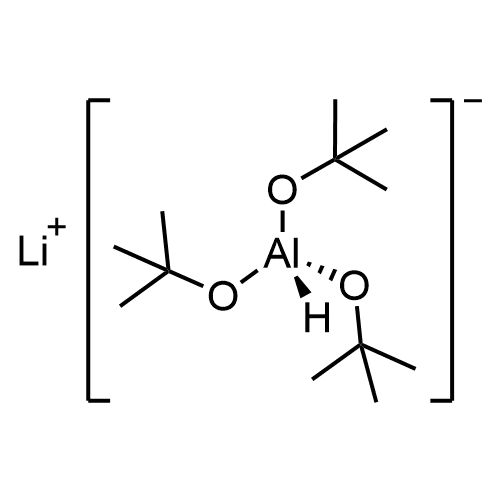
Lithium-tri-(tert-butoxy)-Aluminum Hydride, typ. 30 % solution in THF (typ. 1.1 M)
Li(H9C4O)3AlH
Lithium-tri-(tert-butoxy)-aluminum hydride (LTTBA, CAS 17476-04-9) is a complex metal hydride with the formula Li(t-BuO)3AlH. It is supplied as a typical 30% solution in THF.
It is primarily used as a mild and selective reducing agent in organic synthesis. Examples include reductions of acid chlorides to aldehydes, stereoselective reductions of carbocyclic and steroid ketones as well as chemoselective reductions of aldehydes and ketones in the presence of halogen-, ester-, amide- or nitrile groups.
LTTBA reacts readily with moisture and oxygen and should be handled under dry, inert conditions. Consult the SDS and site-specific procedures for compatible materials, fire response, and storage.
Applications
Reduction of acid chlorides to aldehydes. Stereoselective reductions of carbocyclic and steroid ketones. Reduction of aldehydes and ketones, leaving unaffected halogen-, ester-, lactone, amide-, nitrile-, nitro- and/or epoxy-groups as well as carbon and carbon multiple bonds.
Specifications
- LTTBA: 29 - 32 %
Method of Analysis
Gasvolumetric determination. Detailed description available on request.Handling Instructions
Dilute spilled solution with paraffin oil (but never with halogenated hydrocarbons, alcohols, ketones, esters) and cover with dry sand, ground limestone or cement. The soaked material should then be taken to a safe place and be decomposed. Pay attention to official safety regulations (see also “Transport Regulations“ and “Marking“). In use may form flammable/explosive vapor#air mixtures. Harmful in contact with skin and if swallowed. Keep under argon or nitrogen. Keep container in a well ventilated place. Never add water to this product. Take precautionary measures against static discharges. In case of fire use powder based on sodium chloride or limestone powder. Never use water, halons or carbon dioxide.
Storage Instructions
When stored according to the SDS, the solutions are fairly stable. However, even at room temperature slight decomposition with evolution of hydrogen is observed after prolonged storage. As decomposition accelerates with temperature, we recommend not to (continued) exceed a storage temperature of 20 °C and to use the product within a period of six months after receipt. Higher temperatures can be temporarily accepted, for example, during transport.
Legal Disclaimer
The information presented herein is believed to be accurate and reliable but is presented without guarantee or responsibility on the part of Albemarle Corporation and its subsidiaries and affiliates. It is the responsibility of the user to comply with all applicable laws and regulations and to provide for a safe workplace. The user should consider any health or safety hazards or information contained herein only as a guide and should take those precautions which are necessary or prudent to instruct employees and to develop work practice procedures in order to promote a safe work environment. Further, nothing contained herein shall be taken as an inducement or recommendation to manufacture or use any of the herein materials or processes in violation of existing or future patent.