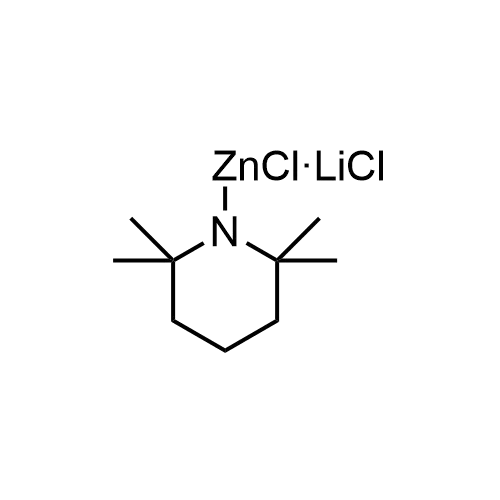
Zinc Chloro 2,2,6,6-Tetramethylpiperidide Lithium Chloride Complex, typ. 17 % solution in THF (typ. 0.7 M)
C9H18NZnCl · LiCl
Zinc Chloro 2,2,6,6-Tetramethylpiperidide Lithium Chloride Complex (TMPZnCl·LiCl, CAS 1145881-09-9) is a mixed Mg/Li amide with molecular formula C9H18NZnCl · LiCl. It is supplied as a typical 17% solution in THF.
It is commonly used as a strong non-nucleophilic base for selective deprotonations. Main applications include deprotonations of (hetero-)arenes often in ortho-position to directing groups. It offers access to Organozinc compounds for Negishi couplings.
TMPZnCl·LiCl reacts readily with moisture and oxygen and should be handled under dry, inert conditions. Consult the SDS and site-specific procedures for compatible materials, fire response, and storage.
Applications
Selective deprotonation of arenes and heteroarenes. Arenes and heteroarenes are typically deprotonated by a directed lithiation using organolithium compounds or organolithiumamides (e.g. LDA). The high reactivity and nucleophilicity of these reagents often result in unwanted side reactions and preludes the presence of sensitive functional groups like esters or ketones. Additionally, such deprotonation reactions often require low temperatures leading to higher production costs on larger scale. Due to their low kinetic basicity zinc-amides tolerate a lot of functional groups.
Specifications
- active base as TMP-ZnCl 16.0 - 18.5 %
- w/o LiCl
- Zn 0.80 - 0.95 mmol/g
- molar ratio Zn/Li 0.9 – 1.1
Method of Analysis
Determination of Active base by titration with benzoic acid (modified Watson-Eastham titration). Determination of Zinc by complexometric - potentiometric titration. Molar ratio is calculated. Detailed description is available on request.Handling Instructions
Handling Organozinc compounds should only be handled under inert gas. Avoid contact with eyes, skin and clothes as well as inhalation. Vapors may form explosive mixtures with air. Vapors are heavier than air and may spread along floors. Flash-back possible over considerable distance. Use only explosion-proof equipment. Take measures against electrostatic discharges. Protect from frost, heat and sunlight. Never add water, acids or oxidizing materials to the product. In case of fire use dry extinguishers on basis of sodium chloride or limestone powder. Never use water or CO2-extinguishers. Pay attention to the safety data sheet.
Legal Disclaimer
The information presented herein is believed to be accurate and reliable but is presented without guarantee or responsibility on the part of Albemarle Corporation and its subsidiaries and affiliates. It is the responsibility of the user to comply with all applicable laws and regulations and to provide for a safe workplace. The user should consider any health or safety hazards or information contained herein only as a guide and should take those precautions which are necessary or prudent to instruct employees and to develop work practice procedures in order to promote a safe work environment. Further, nothing contained herein shall be taken as an inducement or recommendation to manufacture or use any of the herein materials or processes in violation of existing or future patent.