
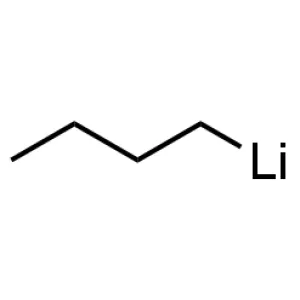
n-Butyllithium, typ. 15 % solution in Hexane (1.6 M)
C4H9Li
n-Butyllithium (CAS 109-72-8) is a lithium alkyl with molecular formula C4H9Li. It is supplied as a solution in Hexane (typically 15%, ~1.6 M) and has a clear pale yellow appearance.
It is used as an initiator for anionic polymerization of olefines such as isoprene, butadiene and styrene. Furthermore, it shows broad synthetic application as a strong base applied for example in (hetero-)arene metalation and as a reagent for halogen-lithium exchange. Further synthetic applications include alkylation and transmetalation reactions.
n-Butyllithium reacts readily with moisture and oxygen and should be handled under dry, inert conditions. Consult the SDS and site-specific procedures for compatible materials, fire response, and storage.
Applications
Initiator for olefin polymerization. Alkylating and metalating agent.
Specifications
Chemical analysis:- active base 14.8 - 15.3 % (1.6 M)
- free base max. 0.3 %
- activity min. 98 %
- Cl (covalent) max. 0.03 %
- mainly LiOC4H9
Handling Instructions
Under exclusion of air and humidity the solution is fairly stable (decomposition rate at 20 °C: abt. 0.06 %; at 35 °C: abt. 0.5 % of active material per month). Decomposition does not cause pressure build up in containers. Butyllithium should always be handled under inert gas like nitrogen although hydrocarbon solutions of n-butyllithium in concentrations of LiR up to about 25 % normally do not ignite spontaneously when coming in contact with air. Increase in concentration due to evaporation of solvent results in rising danger of selfignition.
Storage Instructions
After longer storage, solution of Butyllithium tend to form finely dispersed LiH which is very likely to ignite when in contact with air. Pay attention to official safety regulations (see also "Transport regulations" and "GHS Hazard Pictograms", especially fire fighting). Please ask for our Butyllithium brochure.
Legal Disclaimer
The information presented herein is believed to be accurate and reliable but is presented without guarantee or responsibility on the part of Albemarle Corporation and its subsidiaries and affiliates. It is the responsibility of the user to comply with all applicable laws and regulations and to provide for a safe workplace. The user should consider any health or safety hazards or information contained herein only as a guide and should take those precautions which are necessary or prudent to instruct employees and to develop work practice procedures in order to promote a safe work environment. Further, nothing contained herein shall be taken as an inducement or recommendation to manufacture or use any of the herein materials or processes in violation of existing or future patent.
Related
-
 n-Butyllithium, typ. 10.5 % solution in Toluene (1.4 M)CAS Number:109-72-8
 -
n-Butyllithium, typ. 20 % solution in Cyclohexane (2.3 M)CAS Number:109-72-8
-
n-Butyllithium, typ. 20 % solution in Toluene (2.7 M)CAS Number:109-72-8
-
n-Butyllithium, typ. 23 % solution in Hexane (2.5 M)CAS Number:109-72-8
-
n-Butyllithium, typ. 24 % solution in Cyclohexane (2.8 M)CAS Number:109-72-8
-
n-Butyllithium, typ. 24 % solution in Hexane (typ. 2.5 M)CAS Number:109-72-8
-
n-Butyllithium, typ. 29 % solution in Heptane (typ. 3.2 M)CAS Number:109-72-8
-
n-Butyllithium, typ. 30 % solution in Hexane (3.3 M)CAS Number:109-72-8
-
n-Butyllithium, typ. 90 % solution in Hexane (10.7 M)CAS Number:109-72-8