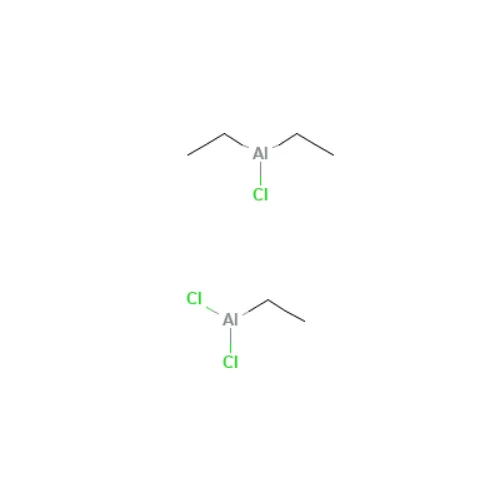
Ethylaluminum Sesquichloride (EASC)
(C2H5)3Al2Cl3
Ethylaluminum sesquichloride (EASC) is used primarily as a catalyst component in Ziegler-Natta type systems for olefin and diene polymerizations. Other applications include ethylation of metals and certain organic carbonyl compounds. EASC can be used as a catalyst in Friedel-Crafts alkylations and acylations.
Handling Instructions
The pyrophoric nature of EASC presents potential hazards not common to most liquid chemicals used by industry. EASC, being pyrophoric, breaks into flame spontaneously. EASC gives off dense smoke when exposed to air and may react violently with water. EASC is a clear, noncorrosive mobile liquid with a low vapor pressure. Hydrocarbon solutions of EASC, depending on the concentration and temperature, may not be pyrophoric. However, these solutions must still be blanketed with an inert gas such as dry nitrogen because EASC will react with air and moisture at the surface of the solution, giving off dense smoke, heat and flammable gas. For specific information on the safe handling and toxicity of this product, please refer to the Material Safety Data Sheet, which is available upon request.
Legal Disclaimer
The information presented herein is believed to be accurate and reliable but is presented without guarantee or responsibility on the part of Albemarle Corporation and its subsidiaries and affiliates. It is the responsibility of the user to comply with all applicable laws and regulations and to provide for a safe workplace. The user should consider any health or safety hazards or information contained herein only as a guide and should take those precautions which are necessary or prudent to instruct employees and to develop work practice procedures in order to promote a safe work environment. Further, nothing contained herein shall be taken as an inducement or recommendation to manufacture or use any of the herein materials or processes in violation of existing or future patent.